Approx 7 min read
Written by Mike Gluckman, Co-Founder of Path Community
—
We’ve spent a lot of time researching this at Path Community, for fairly obvious reasons. Understanding what makes us men tick, and where we sit on this journey of personal growth, is central to our work.
So where are you really? And why is it that many of us, myself included, get stuck?
There’s a decent chance you’re doing fine. Job’s fine. Marriage is fine, mostly. You get up, you get on with it, and by every measure anyone’s checking, you’re holding it together.
“Doing fine” and “living well” aren’t the same thing though. Somewhere between the two, a gap opens up — one you can probably feel even if you’ve never put words to it.
According to Mind, 40% of men in the UK don’t talk about their mental health, mostly out of fear of looking weak. The government’s own research, published alongside England’s first Men’s Health Strategy in November 2025, found 54% of men had avoided seeking medical help in the last three years — same reason.
This isn’t about capability. You’re capable — that’s never been the question. It’s about awareness, and having something to act on once you’ve found it. Knowing where you stand is the first move.
The Four Levels
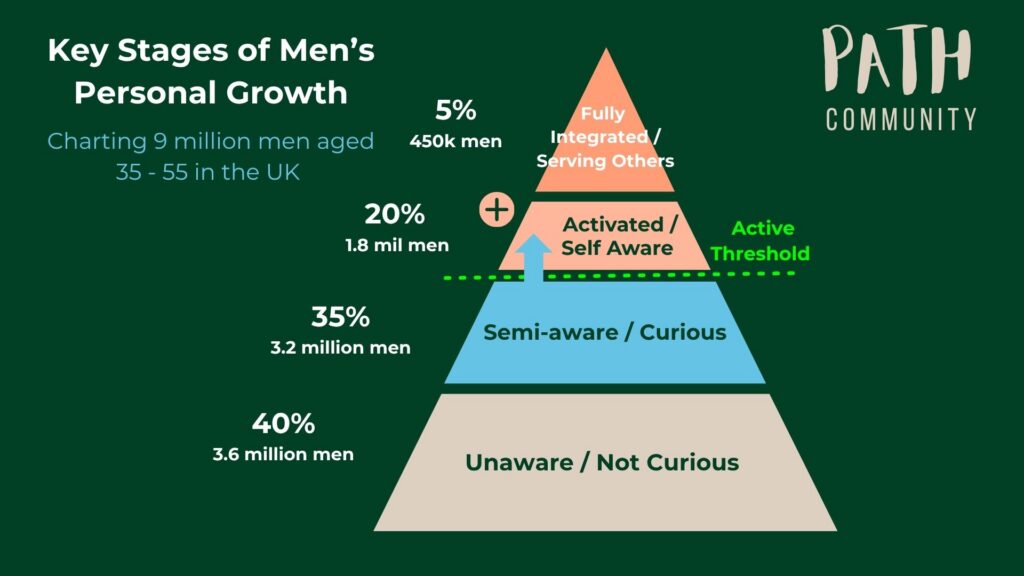
When you map British men aged 35 to 55 against their relationship with self-awareness, four groups consistently show up. The percentages are estimates, built from patterns in our own work alongside the wider research, applied to the roughly 9 million men in this age bracket in the UK today.
Read these honestly. Not as the man you’d like to be, or the one you present at work. The one you actually are on a Tuesday evening, when nobody’s watching.
Level 1: Unaware — roughly 40%, 3.6 million men
You snap at your kid over something small, feel bad for ten minutes, then forget it happened. The argument with your partner resolves the way it always resolves — not really, just enough to go to bed. That’s just life. You deal with it and move on. None of it feels worth examining.
You’re probably not struggling in any obvious way. You might be doing well by most measures. But — to borrow a phrase from the research — you may be suffering in silence anyway. Not because you’re in pain, but because the idea that there might be more depth, more connection, more aliveness available to you hasn’t landed yet.
“Men can be less likely to seek help and more likely to suffer in silence.” — England’s Men’s Health Strategy, Department of Health and Social Care, November 2025
Worth sitting with that a second longer than feels comfortable.
Level 2: Semi-aware and curious — roughly 35%, 3.2 million men
You know something isn’t quite right, even if you can’t name it. A flatness that won’t shift. The sense that you’re performing a version of yourself rather than being yourself. Tension at home that never fully resolves. A feeling, somewhere between Sunday evening and Monday morning, that there has to be more than this.
You’ve maybe bought the book, listened to the podcast, had the conversation that made you think. You’re curious. But you haven’t found the structure, or the people, to do anything with it.
This is where most men your age sit. It’s also the most frustrating place to be — close enough to the edge to feel it, not yet across.
I’ve personally lived here for a long time before Path was created. Probably longer than I’d like to admit.
Level 3: Activated — roughly 20%, 1.8 million men
You’ve crossed a line. You’re not just curious anymore; you’re doing the work. You’ve got practices that aren’t up for negotiation — a morning routine, a therapist or coach, a group of men you meet with regularly. Real time, real money, real honesty.
The distinction that matters: a curious man listens to a podcast about communication. An activated man actually practises being vulnerable with his partner, even when every instinct in him is screaming to change the subject and put the football on instead. You’re not looking for the solution anymore. You’re in the process.
Level 4: Integrated — roughly 5%, 450,000 men
You’ve built something genuinely different, over years of sustained effort. Physically in shape, without it being a performance. Emotionally in tune — you know what you’re feeling and why, without being ruled by it. You can stay steady under real pressure, navigate conflict without shutting down or escalating, and show up fully in your relationships.
You’ve also done the harder, quieter work: looking honestly at why you react the way you do, where that came from, and which habits you built years ago to survive a chapter that’s long since ended but is, in ways you probably can’t fully see yet, still quietly running the show. The focus has shifted from what you can get to what you can give. That shows up in the small, unglamorous ways your wife, your kids, and your friends actually feel it — more presence, more patience, less of you needing something from them in return.
Almost nobody gets here by accident.
Which level are you on right now? And is that where you want to stay?
The Gap That Actually Matters: Curious to Committed
If you recognise yourself in Level 2, you’re in the most common position — and the most consequential one. The gap between curious and committed isn’t about intelligence or ambition. It comes down to three things.
Knowing isn’t doing. You’ve probably already consumed plenty of content on personal development, emotional intelligence, relationships. You know, intellectually, that something needs to change. But knowledge about change and the experience of it are different things entirely. You can read every book on swimming there is and still go under the first time you’re actually in the water.
Awareness without structure stalls. Knowing something’s off is the start, not the destination. Without a process, a regular practice, and someone holding you to account, awareness loops back on itself — you become more conscious of the gap without closing it. Not weakness. Just what happens when you try to change alone, with no map and no one walking it with you.
Community is the missing piece. This was the one I underestimated most in my own journey — a fairly basic mistake for a man who’d built half his career on understanding what makes people commit to things. Every bit of research into what actually moves men from awareness to action points to one thing above the rest: being around other men doing the same work. Not men performing wellness at each other — men genuinely in it, together. The isolation of trying to do this alone is one of the main reasons men stall out at Level 2.
“The most effective aspect of a support group for men was being amongst others with shared life experience, which established mutual respect, understanding and empathy.” — Vickery, Health & Social Care in the Community (2022), Cardiff University
The crossing from curious to committed isn’t one moment of sudden motivation. It’s a decision you make once, then remake every day — to stop waiting, and start.
Why This Matters More Than It Looks Like It Does
Staying at Level 1 or 2 rarely causes a crisis. No breakdown, no obvious moment things went wrong. That’s exactly what makes it easy to stay there. The cost is quieter: a relationship that never quite reaches the depth it could, kids who grow up with a dad in the room but somehow not fully there, a life that looks right from the outside and doesn’t quite feel like yours from the inside.
Jung put it simply: “Until you make the unconscious conscious, it will rule your life, and you shall call it fate.” For a lot of us, that unconscious runs quietly in the background most days — in the argument that keeps repeating, the distance that won’t close, the restlessness that shows up on a Sunday evening for no obvious reason. Not fate. Not bad luck. Just a pattern you haven’t looked at yet.
What Crossing Over Actually Looks Like
Men who move from Level 2 to Level 3 rarely describe it as dramatic. More often, it’s a moment of honest reckoning followed by a decision to stop waiting: committing to a process rather than more content about one, being honest with at least one other person, accepting discomfort as part of it rather than a warning sign, showing up especially when motivation is low, and finding other men doing the same — which turns this from a solo effort into a shared one.
You don’t become a different person crossing over. You become more fully yourself. The reactivity settles. The relationships deepen. The autopilot feeling gets replaced, often for the first time in years, by something that actually feels like choice.
Where to Go From Here
If you recognise yourself somewhere in this, the most useful next move isn’t to act immediately. It’s to get honest about where you actually are, and what staying there is costing you.
If you’re at Level 1 or 2: if nobody else was watching and nothing was at stake, what would you actually want your Tuesday evenings to feel like? We go into that properly in our companion piece, What Does a Fulfilling Life Actually Look Like for a Man?
If you already know enough, and what’s missing is structure and people — that’s what we built Path for. Structured training across five pathways of male fulfilment, an online community, men’s circles, and shared experiences including treks and camping trips. Built to move you from awareness into change that actually lasts.
Nine million men. Four levels. One crossing worth making.
Sources & Further Reading
Mind (2024). Men and Mental Health: Stigma, Barriers, and Help-Seeking Behaviour. mind.org.uk
Department of Health and Social Care (November 2025). Men’s Health: A Strategic Vision for England. gov.uk
Vickery, A. (2022). Men’s experiences of using mental health support groups. Health & Social Care in the Community, 30, 2383–2391. Cardiff University.
ONS (2025). Population Estimates for the UK, England, Wales, Scotland and Northern Ireland: Mid-2024. The figure of roughly 9 million UK men aged 35–55 used throughout this piece is drawn from these official estimates. ons.gov.uk
Prochaska, J.O. & DiClemente, C.C. The Transtheoretical Model of Health Behaviour Change. The wider research on behaviour change consistently shows that people in any given population sit across a small number of distinct readiness stages, rather than being evenly or randomly distributed — the same underlying pattern our four levels are built on.
Priory Group (2023). Men’s Mental Health Survey: 1,000 UK Men. A separate, independent survey reaching a similar picture to the research cited above: most men carry something they haven’t acted on. priorygroup.com
BACP (2026). Public Perceptions of Counselling and Psychotherapy. This annual YouGov-backed survey of 5,000+ UK adults found 29% of men have seen a therapist — a useful independent benchmark for how many men are taking the kind of concrete action that defines our Activated tier. bacp.co.uk
Cardiff University, Self-Organized Men’s Mental Health and Well-Being Groups (2025). Notes that Andy’s Man Club, one of the UK’s largest men’s peer-support networks, now operates in 240 locations nationally — a real-world indicator of the scale of men actively engaging in structured peer support, rather than just being aware they might benefit from it.