
How many emotions can you name?
Ask most men how they’re feeling and you’ll get one of three answers: fine, stressed, or angry. Not because that’s all that’s actually going on inside. Because that’s all the words they’ve got.
This is emotional literacy, and most men were never taught it. Not because anyone sat them down and told them not to feel things. It’s quieter than that. It’s twenty years of “shake it off,” “man up,” and rooms that went silent the moment a boy cried. By adulthood, you’ve had a lifetime of practice hiding what you feel and almost none practising what to do with it.
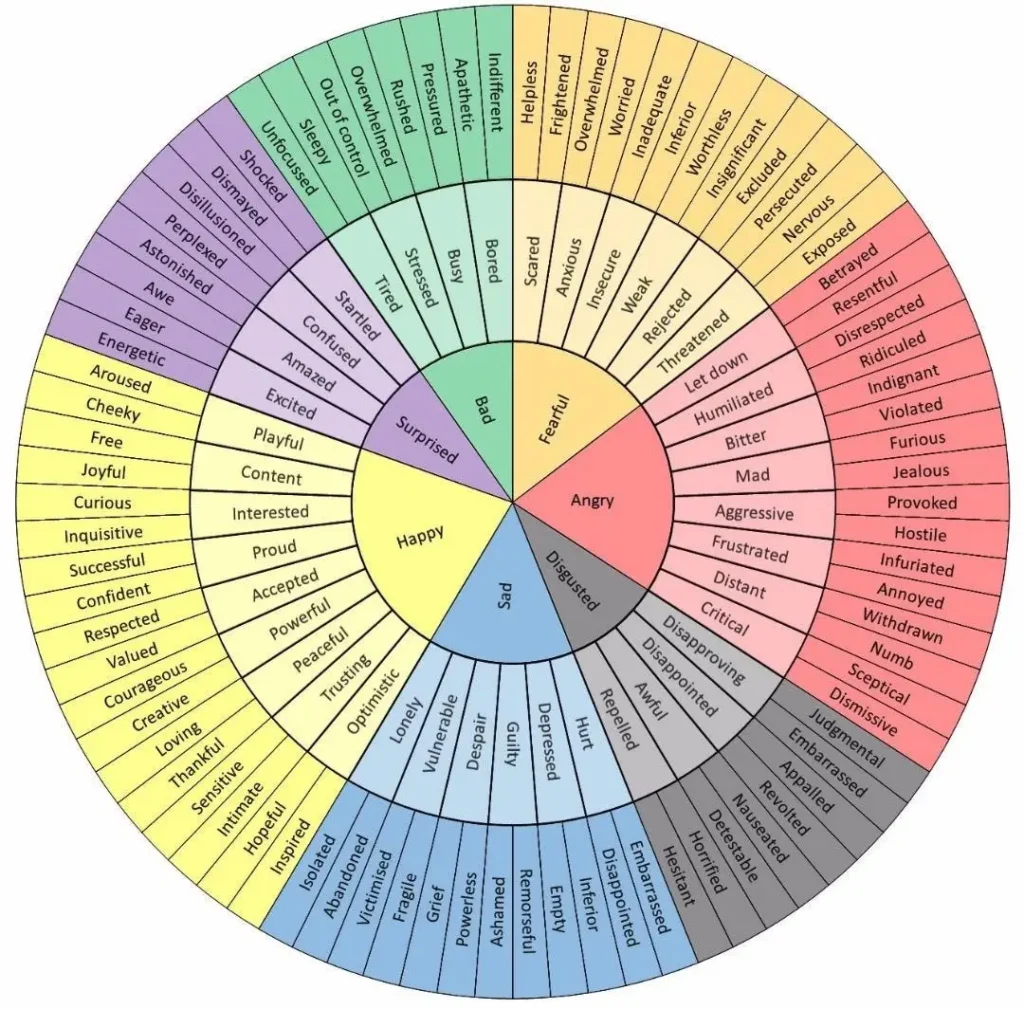
Take a look at the wheel of emotions below. Seven core feelings sit at the centre: happy, sad, angry, fearful, disgusted, surprised, and bad. Fine. Most men could name those. But look at what surrounds them. Sixty odd words ringing the outside, each one a more precise version of the feeling in the middle. Furious is different from resentful. Betrayed is different from disrespected. Isolated is different from abandoned, which is different again from powerless. That’s the whole point of this article. Not that men don’t feel things. It’s that most men are stuck in the centre of that wheel, using six or seven words to describe an experience that actually has sixty.
The result is a man who looks composed on the outside and has no real idea what’s happening underneath. Stoic on the outside, drowning on the inside.
Emotions are data, and half a dataset is a bad dataset
Emotions aren’t decoration. They’re information. Anger tells you a line’s been crossed. Sadness tells you something mattered and you lost it. Shame tells you there’s a gap between who you are and who you want to be. Every one of them is a signal, and you use those signals to make decisions.
Here’s the problem. Most men have only been given permission to access the emotions that convey power: anger, confidence, drive. The rest of the spectrum, the ones that come with vulnerability like grief, fear, embarrassment, tenderness, gets shut out entirely. That’s not emotional control. That’s working from half a dataset. And decisions made on half a dataset are rarely the right ones, for you or for the people around you.
The path most men are on without realising it
There’s a pattern that plays out for a lot of men who never got the chance to build a relationship with their emotional world, and it’s worth naming because most men are somewhere on it right now without knowing it.
It starts with no vocabulary. You feel something but you don’t have the words for it, so everything gets flattened into mad, sad, or happy, the core of the wheel and nowhere further out. You’re never in the sharp, specific version of the feeling. You never get to say “I feel embarrassed” or “I feel proud and hurt at the same time.” You stay stuck in the middle ring instead of reaching the outer one, where the actual detail lives.
Then it becomes a mood. When you can’t name the individual feeling, your brain does the next best thing and gives you a general mood instead. A gloomy day. An angry week. Moods are a mashup of a dozen smaller feelings you never got specific about. They give you something to express, which feels like relief, but they don’t give you clarity. You know you’re in a mood. You have no idea what’s actually underneath it.
Then apathy sets in. String enough undiagnosed moods together for long enough, months, years, sometimes decades, and the natural next stop is flatness. Minor ups, minor downs, general lack of interest in things that used to matter. Picture standing in front of a twenty-foot wall with no rope, no stairs, no tools, and no one to help you up. That’s what it feels like to carry decades of unspoken feeling with no way to climb out of it. Eventually you stop trying. Apathy isn’t laziness. It’s exhaustion dressed up as indifference.
Then it tips into the extremes. Depression on one end, anger on the other. And for a lot of men, anger becomes the default because it’s the one emotion they were always allowed to feel loudly. Anger feels powerful. It feels alive. After years of feeling flat and unseen, it can even feel earned. But anger aimed outward doesn’t fix anything, because the actual problem was never out there. It was internal: years of feelings with nowhere to go. Real power doesn’t come from the eruption. It comes from finally being able to name what’s underneath it.
If any part of that progression sounds familiar, you’re not broken and you’re not unusual. You’re just a man who was never taught the skill. Which means it’s a skill you can still build.
Why this matters more than it looks like it does
This isn’t really about feelings for their own sake. It’s about function.
Your partner doesn’t need you to have it all figured out. She needs honesty about where you actually are. “I’m on edge and I think it’s about the conversation I’m avoiding with my brother” builds more trust than a flawless performance of being fine, every time.
Your kids are watching how you handle what you feel, not just what you say about it. A dad who can say “I’m frustrated, I need a minute” is teaching a skill for life. A dad who goes quiet or snaps is teaching something too, just not the thing he’d choose to.
And at work, the men who can read a room and stay level under real pressure aren’t the ones who’ve switched their emotions off. They’re the ones who’ve actually processed what they feel, so it’s not leaking out sideways all day. People can tell the difference, even when they can’t say why.
Tips and tricks: building emotional literacy from here
You don’t need a breakthrough to start. You need a practice. Here’s where to begin.
1. Admit there’s a gap. The first step is just being honest that you might not be great at naming what you feel. That’s not a failure. It’s the starting point every man on this path has to pass through. You can’t build a skill you won’t admit you’re missing.
2. Use the wheel to get specific. Next time you catch yourself reaching for mad, sad, or stressed, stop and go to the wheel. Start in the centre with the core feeling, then work outward. If the centre says angry, don’t stop there. Is it frustrated, resentful, or actually betrayed? If the centre says sad, is it lonely, powerless, or genuinely grieving something? The outer ring exists because your insides are more detailed than the middle ring lets on. Keep the wheel somewhere you’ll actually see it, on your phone, on the fridge, on your desk, and use it deliberately until picking the precise word starts to happen without thinking.
3. Keep a feeling journal, wheel in hand. Once a day, write down what you actually felt, not just what happened. Check the wheel before you write. Even two lines is enough. “Felt disrespected after that call. Underneath it, I think I actually felt inadequate.” Over time this builds the muscle that most men never got to build growing up, and the wheel gives you the raw material until the words start coming on their own.
4. Use every low-stakes chance to practise. This doesn’t have to be heavy. Using a more precise word in a text, choosing an emoji that actually matches how you feel rather than a default thumbs up, all of it counts. Emotional literacy is built through repetition in small moments, not one big revelation.
5. Switch to I-language. Instead of “you’re making me angry,” try “I feel angry when this happens.” When we can’t own what we feel, we tend to hand the responsibility for it to someone else. Taking that responsibility back is what makes the feeling yours to work with instead of someone else’s to fix.
6. Ask yourself the question daily. Every day for the next 30 days, ask yourself: what am I actually feeling right now? Write the answer down. This single habit, done consistently, does more for emotional literacy than almost anything else on this list. Knowing what you feel is how you find out what you actually want and need. And you can’t ask for what you want and need if you don’t know what it is.
7. Say it out loud to someone who won’t flinch. This is the part most men skip because it’s the hardest part. A feeling that’s stayed in your own head on repeat lands completely differently once it’s been spoken to another person. This is exactly what a space like the Path Community is built for: a room where saying the honest thing isn’t a risk, it’s the whole point.
8. Expect it to feel clumsy before it feels natural. You’re building a skill that most of your life actively discouraged. It will feel effortful for a while. That’s not a sign you’re doing it wrong. That’s just what learning looks like.
The bottom line
You don’t fix a lifetime of emotional flatness by trying harder to look calm. You fix it by getting specific, practising daily, and saying the true thing to someone who’ll actually hear it. The men who do this work aren’t the ones falling apart. They’re the ones who stopped waiting to fall apart before they finally started paying attention.
You’ve had years of practice going quiet on the inside. It’s worth spending some time now learning how to speak that language back to yourself.