Most of us think of narcissism as something other people have. A boss who takes the credit. An ex who never once said sorry. A mate who somehow makes every conversation about him.
Fewer of us stop to ask where we sit on the same line.
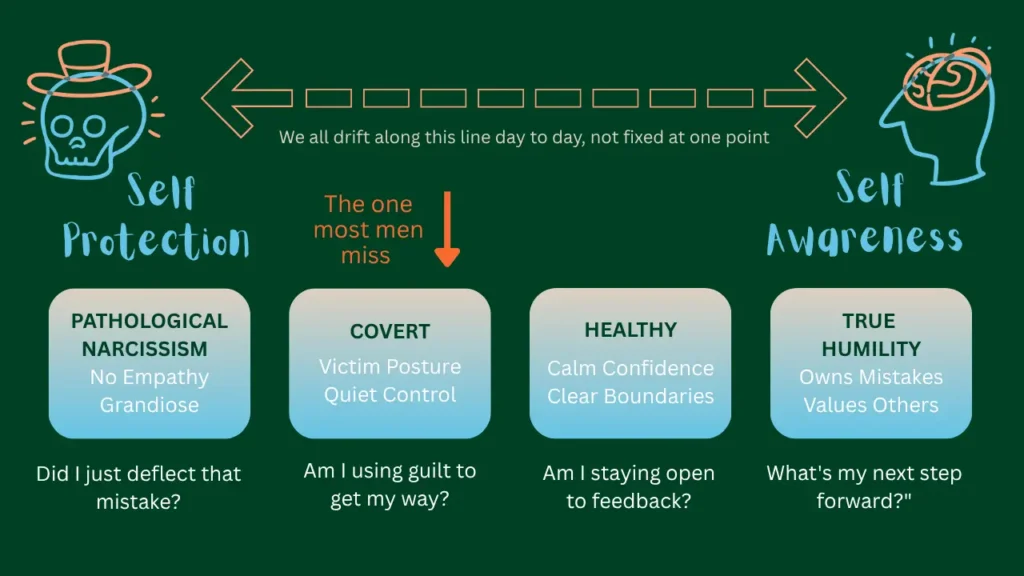
That’s the useful reframe. Narcissism and humility aren’t two separate boxes, one labelled bad and one labelled good, with most people safely outside both. They’re two ends of a single spectrum, and everyone is somewhere on it. Not fixed there either. You can drift up and down depending on the week, the stress you’re under, and how much sleep you got.
Understanding the spectrum gives you a tool. Not for diagnosing your father-in-law. For checking yourself.
The four points on the line
Pathological narcissism sits at the far end. This is grandiosity with teeth: a genuine lack of empathy, a habit of using people, and an ego so fragile that ordinary feedback lands like an attack. Someone here doesn’t experience criticism as information. They experience it as a threat to their existence, and they’ll fight, deflect, or punish to make that threat go away.
Covert narcissism is the one most men miss, including in themselves. It doesn’t look like arrogance. It looks like martyrdom. The endless self-deprecation, the quiet suffering, the “I always give and never get anything back.” It can be a real feeling. It can also be a strategy, consciously or not, for pulling sympathy and control out of the people around you without ever having to ask directly. Worth sitting with that one for a second, because it’s the one that hides best behind humility’s clothing.
Healthy self-regard is the centre, and it’s easy to undersell because it doesn’t announce itself. It’s just normal confidence. You know your worth, you protect your time and your boundaries, and you don’t need to diminish anyone else to feel steady. Most well-adjusted people live here most of the time. It’s not a virtue you’re chasing. It’s closer to a baseline you’re trying to return to.
True humility is the far end, and it’s rarer than people assume. Not because it’s some saintly achievement, but because it requires two things that are both uncomfortable: an honest look at your own strengths and weaknesses, and a genuine willingness to say “I was wrong” without needing to soften it or explain it away. Humility isn’t thinking less of yourself. It’s thinking of yourself accurately, and then getting out of your own way enough to notice other people.
Where it actually shows up
You don’t find out where you sit on this line by thinking about it in the abstract. You find out in three specific moments.
How you handle mistakes. The narcissistic end deflects, gaslights, or rages, because the mistake feels like an attack on the whole self rather than a single event. The humble end just owns it. Says the thing plainly, learns from it, moves on. If you notice yourself building a case for why it wasn’t really your fault before you’ve even finished apologising, that’s worth noting.
How you see other people. On one end, people are tools or obstacles, useful for validation and irritating when they’re not. On the other, people are worth listening to on their own terms, not just as an audience for your story. This one’s subtle. You can be generous with your time and still be quietly using people for how they make you feel about yourself.
What’s actually driving you. Underneath everything on the narcissistic end is one job: guard the inflated image of yourself against reality, at almost any cost. Underneath the humble end is a much lighter job: stay curious, stay open to being corrected, keep your picture of the world roughly accurate. One of these is exhausting to maintain. The other one, oddly, is a relief.
Why this matters for the men we talk to at Path
A lot of the men who find their way into this community aren’t narcissists in the clinical sense. But plenty of us were raised in a version of masculinity that rewarded the wrong end of this spectrum without ever naming it. Never show weakness. Never apologise first. Win the room. Be the one who doesn’t need anyone.
That training doesn’t produce healthy self-regard. It produces men who look confident and feel brittle, who can’t take feedback without it costing them something internally, and who mistake being right for being respected.
The good news is that this spectrum isn’t a personality type you’re stuck with. It’s more like a set of habits you’re either reinforcing or interrupting, most days, without noticing. Every time you own a mistake instead of explaining it away, you move a fraction toward the humble end. Every time you actually listen to someone instead of waiting for your turn to talk, same thing.
You’re not trying to become a pushover. Healthy self-regard is still on this map, and it still has boundaries and self-interest built into it. You’re just trying to notice which end you default to under pressure, and build the habit of moving yourself back toward the middle, or further, on purpose.
That’s the whole practice, honestly. Not becoming someone else. Noticing the drift, and correcting for it.
How to actually use the diagram
The diagram isn’t there to help you spot narcissists. It’s there to help you catch yourself mid-drift, in the moment it’s actually happening. Each point on the line has a question attached, and the questions aren’t decoration. They’re the whole point of the exercise.
Run through them like a quick internal check, especially after a conversation that left you unsettled:
Did I just deflect that mistake? This one’s for the moments right after you’ve been called out on something, however small. Notice if your first instinct is to explain why it wasn’t really your fault before you’ve even taken in what was said.
Am I using guilt to get my way? This one catches the quieter pattern. Sighing instead of asking. Going silent instead of saying what you want. If you’re getting your way through someone else’s discomfort rather than a direct conversation, that’s worth a second look.
Am I staying open to feedback? Not “did I hear it” but “did I let it land.” You can nod along to criticism and still be building your defence the whole time. This question is asking whether you actually moved, even slightly.
What’s my next step forward? This is the one that turns the whole exercise from self-judgment into something useful. Awareness on its own doesn’t change anything. Once you’ve noticed where you drifted, this question forces you to name one concrete thing you’ll do differently, not just feel bad about it.
Used regularly, these four questions do more than the diagram’s labels ever could. The labels tell you where you might be standing. The questions are what actually move you.